Sacrificial Animals for Eid ul Adha: Which Animals Are Allowed?
On this page
The sacrificial animals for Eid ul Adha are sheep, goats, cattle (including buffalo) and camels. Nothing else counts. A goat or sheep covers one person, and a cow, buffalo or camel covers up to seven. Minimum ages are 1 year for goats and sheep (or 6 months for a well-grown sheep in the Hanafi school), 2 years for cattle and 5 years for camels.
Qurbani in English means “sacrifice” or “offering”. The word comes from an Arabic root meaning nearness, so it is an offering made to come closer to Allah. Not every animal can be offered, though.
Which animals can be sacrificed on Eid ul Adha?
The Quran calls the sacrificial animals bahimat al-an’am, grazing livestock (Surah Al-Hajj 22:34). Scholars agree this means four kinds:
- Sheep, including rams, ewes and well-grown lambs
- Goats, male or female
- Cattle: cows, bulls, oxen and water buffalo
- Camels, male or female
Chickens, ducks, turkeys, deer, rabbits and fish can’t be used for Qurbani, even though they are halal to eat. Giving one of them would be ordinary sadaqah, not Qurbani.
Age and shares
| Animal | Minimum age | Covers |
|---|---|---|
| Sheep | 1 year, or 6 months if it looks a year old (Hanafi) | 1 person |
| Goat | 1 year | 1 person |
| Cow, bull, ox or buffalo | 2 years | Up to 7 people |
| Camel | 5 years | Up to 7 people |
The sheep exception comes from a hadith in which the Prophet ﷺ allowed a jadha’ah of sheep, a well-grown young sheep (Sahih Muslim 1963). It does not apply to goats. A goat under one year is not valid, however large it is.
The seven-share rule comes from Jabir, who said the Companions sacrificed “a camel for seven and a cow for seven” with the Prophet ﷺ (Sahih Muslim 1318). You can take more than one share, but no one’s share can be less than a seventh.
Health and defects
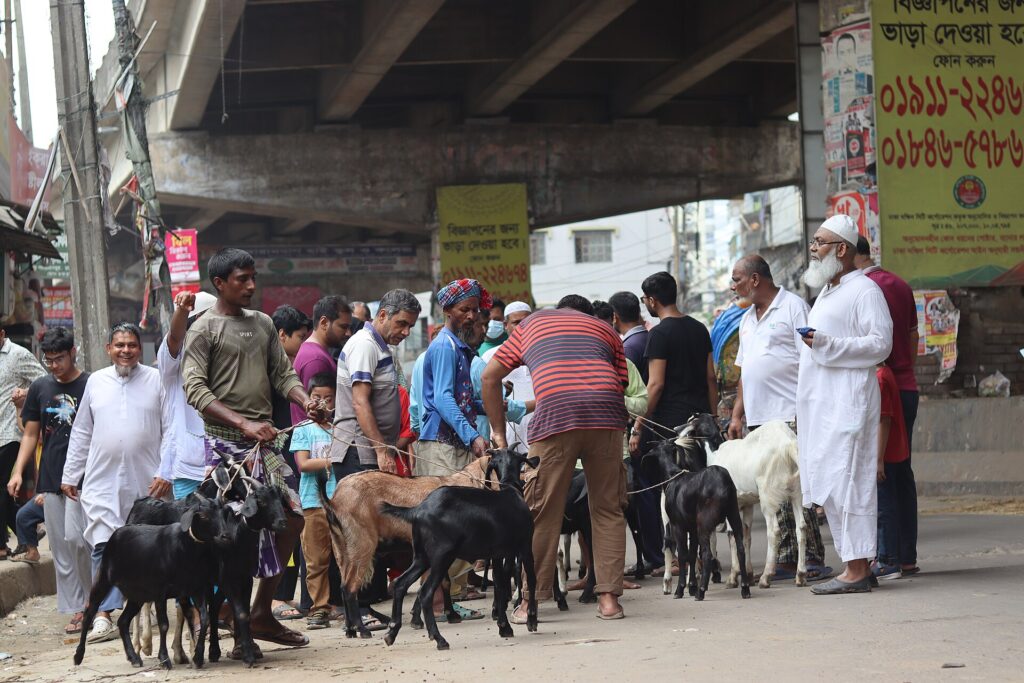
Al-Bara’ ibn Azib reported that the Prophet ﷺ said: “Four will not do for sacrifice: a one-eyed animal whose blindness is clear, a sick animal whose sickness is clear, a lame animal whose limp is clear, and an animal so thin it has no marrow” (Sunan Abu Dawud 2802, Jami’ at-Tirmidhi 1497).
Based on these, scholars also exclude an animal that:
- has lost most of its teeth and can’t graze
- has a horn broken off at the root
- is missing more than a third of an ear or of its tail (Hanafi)
- has a broken leg or can’t walk to the place of slaughter
Things that do not matter
- Male or female: both are valid.
- No horns: an animal born without horns is fine.
- Castrated: fine, and even preferred by some, since the Prophet ﷺ sacrificed castrated rams (Sunan Abu Dawud 2795).
- Colour: any colour is fine. The Prophet ﷺ liked rams that were white with some black.
- Small marks such as a scar, an ear tag hole or a small chip on a horn.
How the animal must be slaughtered
A valid animal still has to be slaughtered properly. It must be alive at the cut. A Muslim says Bismillahi Allahu Akbar, and a sharp knife cuts the windpipe, food pipe and jugular veins. Allah says: “Do not eat of that over which the name of Allah has not been mentioned” (Surah Al-An’am 6:121). The Prophet ﷺ said: “When you slaughter, slaughter well. Sharpen your blade and spare the animal suffering” (Sahih Muslim 1955).
If an animal dies from pre-slaughter stunning before it is cut, it is not halal and there is no Qurbani. Many scholars dislike stunning for Qurbani even when the animal survives. That is one reason so many Western Muslims give their Qurbani abroad.
Which animal should you choose?
- One person, whole animal: a goat or sheep.
- A family of several adults: shares in a cow, or a whole cow for up to seven.
- Most meat for the poor: cattle or buffalo usually give more meat per dollar.
There is a full comparison in cow, goat or sheep Qurbani, and more on goats in goat sacrifice in Islam.
Our animals
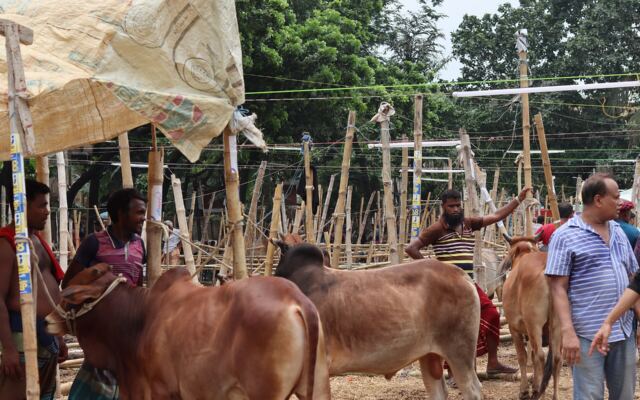
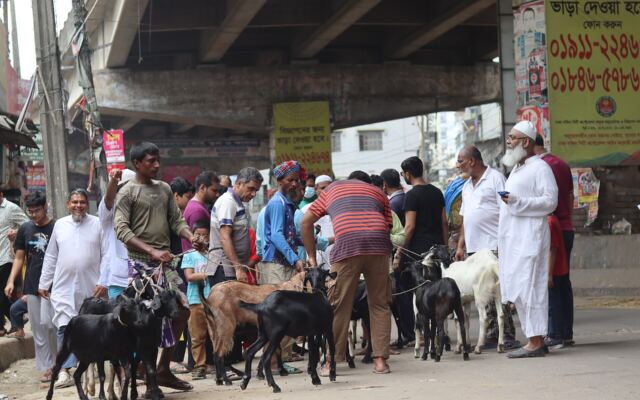
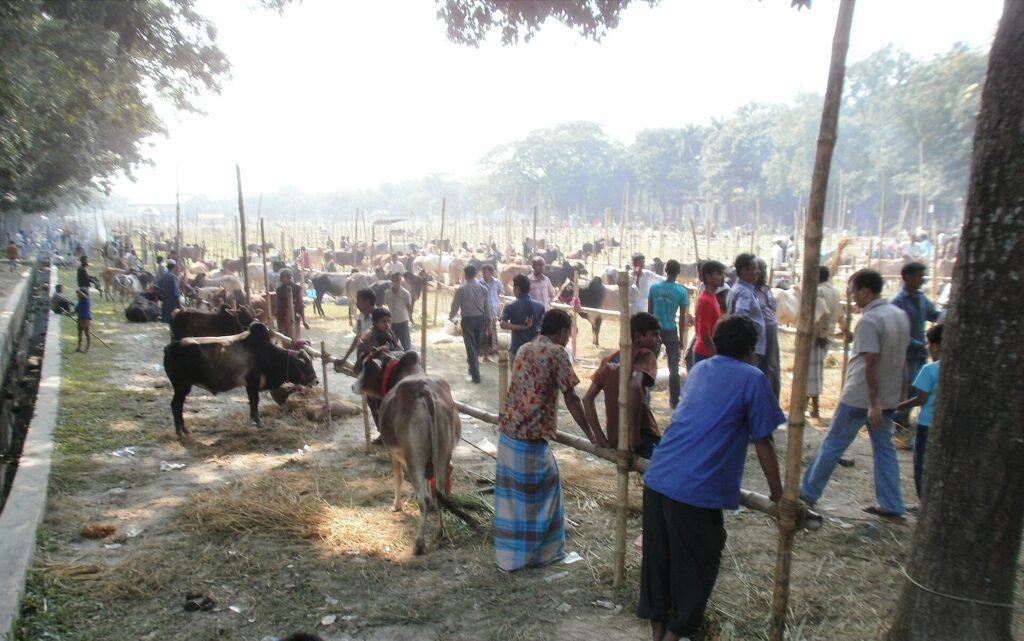
Our team in rural Bangladesh buys every animal at local markets and checks its age (by teeth) and health before buying. Each one is slaughtered by hand after the Eid prayer, with no stunning. The meat goes to Rohingya refugees and poor families, and you get photos and video. A cow share is $170, a sheep $175, a goat $200, a whole cow $1,190, a buffalo $1,500 and a camel $4,450.
Quick questions
Can a husband and wife share one goat? No. A goat or sheep is for one person only. They could take two shares in a cow instead.
How is an animal’s age checked? Usually by its teeth. A goat or sheep of about a year has its first pair of adult teeth.
Can I keep the skin? You can use it or give it away, but you can’t sell it.
For timing, intention and sharing the meat, see the Qurbani rules. Or see how our Qurbani donation works and reserve your animal.
Give your Qurbani with us
We buy healthy animals of the right age in rural Bangladesh and slaughter them by hand after the Eid prayer, with no stunning. The meat goes to Rohingya refugees and poor families, and you get photos and video of your animal.
Reserve from $170 How our Qurbani donation worksDates are estimates based on astronomical calculations and the Umm al-Qura calendar, and depend on the moon sighting. Hadith references include the collection and number so you can check them. Where a narration is graded weak, we say so. Scholars differ on some details, so ask a local scholar about your own situation.