Qurbani Rules: Who Gives, When, Which Animal and How
On this page
Qurbani is due from each adult Muslim who owns the nisab (in the Hanafi school). It is done after the Eid prayer on 10 Dhul Hijjah and up to the 12th, with a healthy animal of the right age, slaughtered alive with Bismillahi Allahu Akbar. The meat is ideally shared in thirds: family, relatives and the poor.
The Qurbani rules are not complicated, but getting one detail wrong can make the sacrifice invalid. Slaughtering before the Eid prayer or choosing a goat that is too young are common examples.
Who has to give Qurbani
In the Hanafi school, Qurbani is wajib on every Muslim who, during the days of Eid, is:
- an adult (has reached puberty) and of sound mind
- resident, not travelling
- the owner of wealth at or above the nisab, after basic needs
The nisab is the same as for Zakat: the value of 87.48 grams of gold or 612.36 grams of silver. Most Hanafi scholars use the silver value, which is much lower. Unlike Zakat, the wealth doesn’t need to have been held for a year. Owning it on the days of Eid is enough.
The Shafi’i, Maliki and Hanbali schools hold that Qurbani is a sunnah mu’akkadah, a strongly recommended Sunnah. The Prophet ﷺ said, “Whoever has the means and does not sacrifice, let him not come near our place of prayer” (Sunan Ibn Majah 3123, graded hasan). For more on this question, see is Qurbani mandatory?
Qurbani rules for families
This is where most questions come from.
- Husband and wife: in the Hanafi school, each is assessed on their own wealth. If the wife owns the nisab herself, for example in gold jewellery, she owes her own Qurbani.
- Children: Qurbani isn’t wajib for children. Parents may give one for them as a voluntary act.
- Adult children living at home: they give their own if they own the nisab.
- The other schools: the Shafi’is, Malikis and Hanbalis hold that one sheep or goat from the head of the household covers the Sunnah for the whole household, based on the Prophet’s ﷺ practice.
So a Hanafi family of four, where both parents and one adult son have the nisab, would give three Qurbanis. That could be three goats, three sheep or three shares of a cow.
When Qurbani can be done
The time starts after the Eid prayer on 10 Dhul Hijjah. The Prophet ﷺ said, “Whoever slaughtered before the prayer should slaughter another in its place” (Sahih al-Bukhari 5562). In places where no Eid prayer is held, such as remote villages in the Hanafi view, it can start after dawn on the 10th.
It ends at sunset on the 12th in the Hanafi, Maliki and Hanbali schools, and at sunset on the 13th in the Shafi’i school. The first day is best. In 2027 the 10th is expected on Sunday, May 16 in North America and the UK. See the Eid al-Adha 2027 date for details.
If you give through a charity in another country, what counts is the time where the animal is slaughtered. For Hanafis, the Eid prayer must have taken place there before your animal is sacrificed.
If you miss the days
A missed Qurbani can’t be made up by slaughtering later. In the Hanafi school, someone who owed it gives the value of a sheep or goat to the poor and asks Allah’s forgiveness.
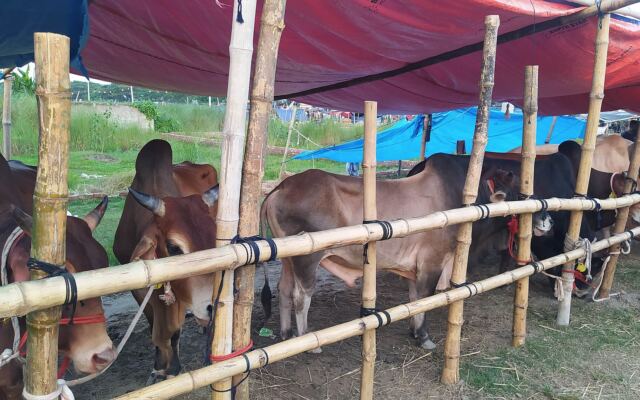
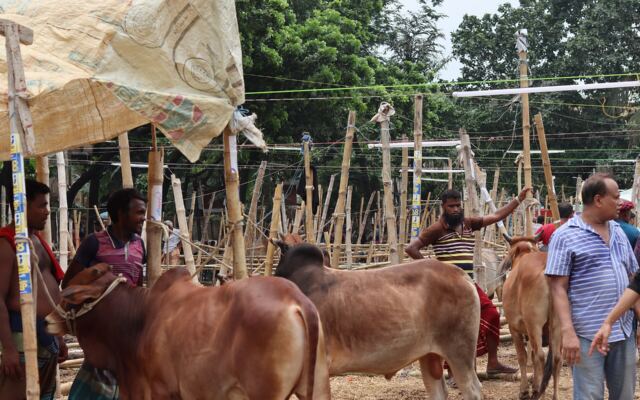
The animal
| Animal | Minimum age | Covers |
|---|---|---|
| Sheep | 1 year, or 6 months if well grown (Hanafi) | 1 person |
| Goat | 1 year | 1 person |
| Cow, bull or buffalo | 2 years | Up to 7 people |
| Camel | 5 years | Up to 7 people |
The animal must not have any of these defects:
- Clear blindness in one or both eyes
- A clear illness
- A limp so bad it can’t walk to the place of slaughter
- Extreme thinness, with no marrow in the bones
These four are named in the hadith (Sunan Abu Dawud 2802, Jami’ at-Tirmidhi 1497). Scholars add others by analogy: most of the teeth missing, a horn broken off at the root, more than a third of an ear or the tail missing, or a broken leg. For help choosing, read cow, goat or sheep Qurbani.
The slaughter
- The animal must be alive at the moment of the cut.
- The person slaughtering is a Muslim and says Bismillahi Allahu Akbar at the cut.
- A very sharp knife cuts the windpipe, the food pipe and the two jugular veins so the blood flows out fully.
- The animal is laid on its left side facing the Qibla.
- The knife is not sharpened in front of the animal, and one animal is not slaughtered in front of another.
These details all come from one instruction: “When you slaughter, slaughter well. Sharpen your blade and spare the animal suffering” (Sahih Muslim 1955). If the animal dies from stunning before the cut, the meat is not halal and there is no Qurbani. Many scholars discourage stunning even when the animal survives it.
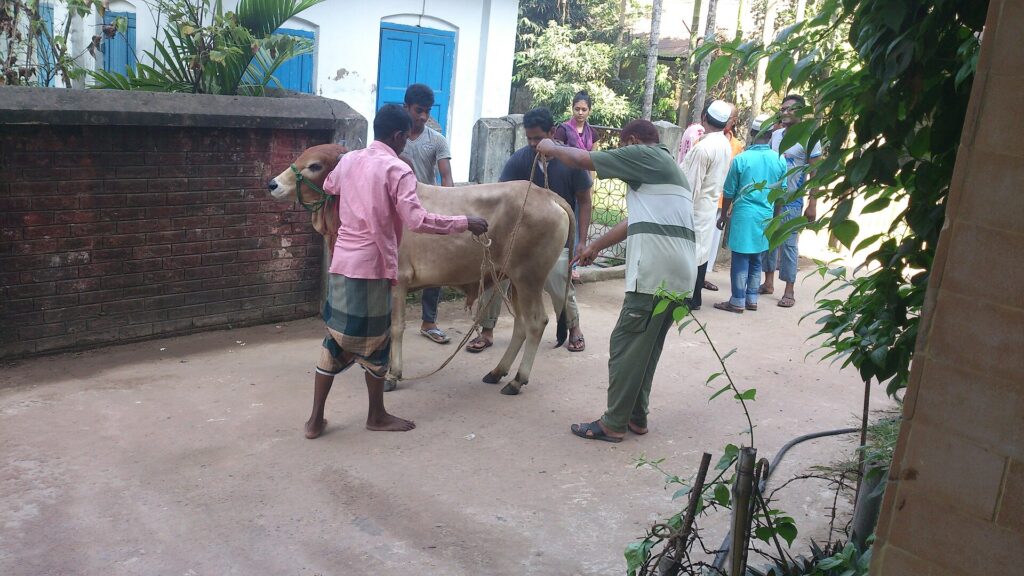
You may slaughter yourself, watch it being done, or appoint someone to do it for you (wakalah), including a charity abroad.
Before Eid: hair and nails
Umm Salamah reported that the Prophet ﷺ said: “When the ten days begin and one of you wants to sacrifice, he should not cut anything of his hair or skin” (Sahih Muslim 1977). This applies to the person giving Qurbani, not to everyone in the household. It ends once your animal has been slaughtered. If you are giving through a charity, it ends once the charity tells you it is done.
Sharing the meat
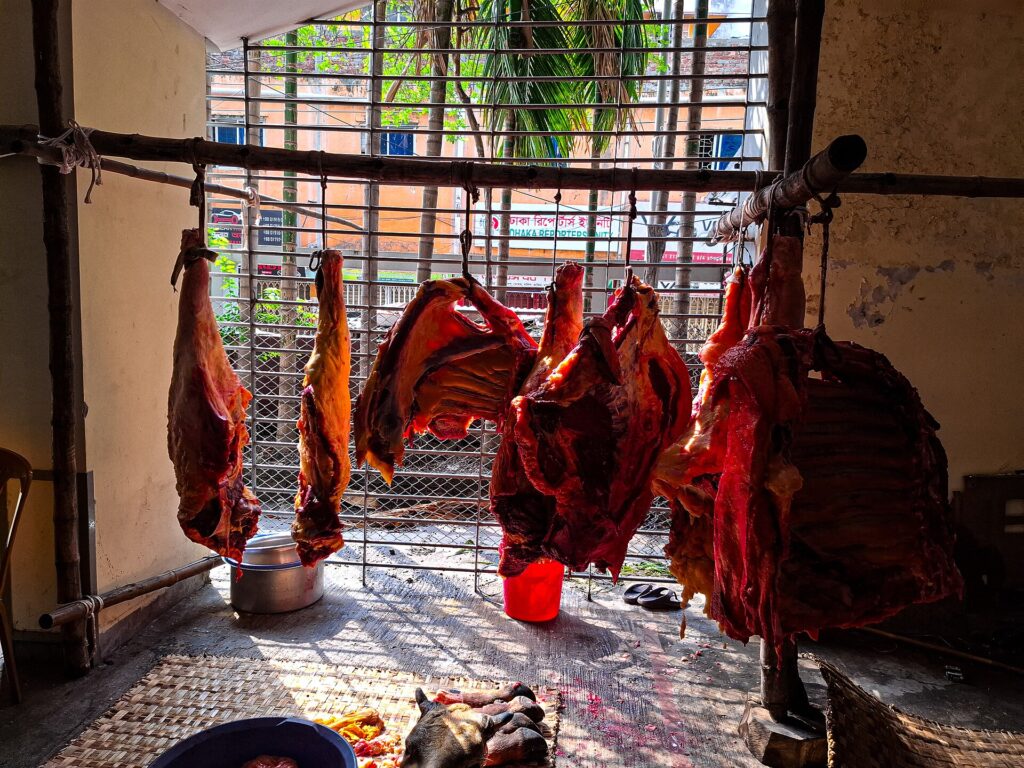
The recommended way is three parts: one for your household, one for relatives, friends and neighbours, and one for the poor. Allah says, “Eat from them and feed the needy who do not ask and the needy who ask” (Surah Al-Hajj 22:36). This split is recommended, not required. Giving all of it to the poor, as you do through a charity, is fine and very rewarding.
- Don’t pay the butcher with meat or skin. Pay a wage (Sahih al-Bukhari 1716).
- Don’t sell any part of the animal. The skin can be used or given away.
- Non-Muslim neighbours may be given meat, according to most scholars.
Qurbani for someone who has died
You can give a Qurbani on behalf of a parent or relative who has passed away, and the reward reaches them. If the person left instructions in their will for a Qurbani to be given, all of that meat should go to the poor.
Common questions
Can I pay a charity by card or bank transfer? Yes. How you pay doesn’t matter. What matters is that the animal is sacrificed in the right days, in the right way.
Is stunning allowed? The animal has to be alive when it is cut. If stunning kills it, the sacrifice is invalid. Many scholars discourage stunning altogether, and we never use it.
Can I give more than one Qurbani? Yes. Extra Qurbanis are voluntary and rewarded, for yourself or for others.
Do travellers give Qurbani? In the Hanafi school, a traveller doesn’t owe it, but can give it voluntarily.
Giving Qurbani with these rules in mind
We built our process around these rules. Every animal is the right age and checked for defects. It is slaughtered by hand after the Eid prayer, alive, with no stunning, and the meat goes to Rohingya refugees and poor families in rural Bangladesh. You can read more about our Sunnah Qurbani donation, or reserve your Qurbani now. If you are new to all this, what is Qurbani? and Qurbani Eid explained are good places to start, and the Udhiyah meaning guide explains the Arabic terms.
Give your Qurbani with us
We buy healthy animals of the right age in rural Bangladesh and slaughter them by hand after the Eid prayer, with no stunning. The meat goes to Rohingya refugees and poor families, and you get photos and video of your animal.
Reserve from $170 How our Qurbani donation worksDates are estimates based on astronomical calculations and the Umm al-Qura calendar, and depend on the moon sighting. Hadith references include the collection and number so you can check them. Where a narration is graded weak, we say so. Scholars differ on some details, so ask a local scholar about your own situation.